

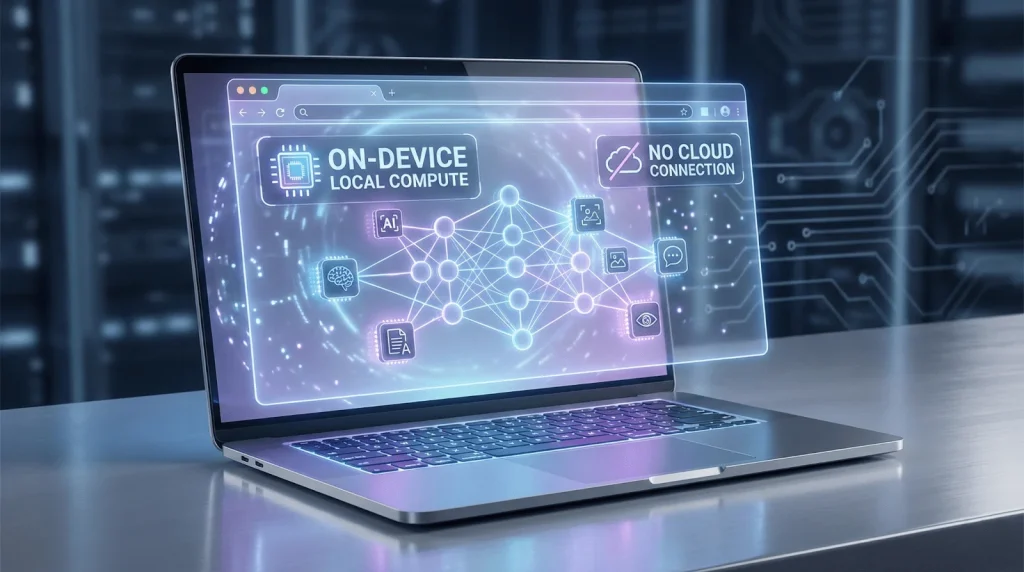
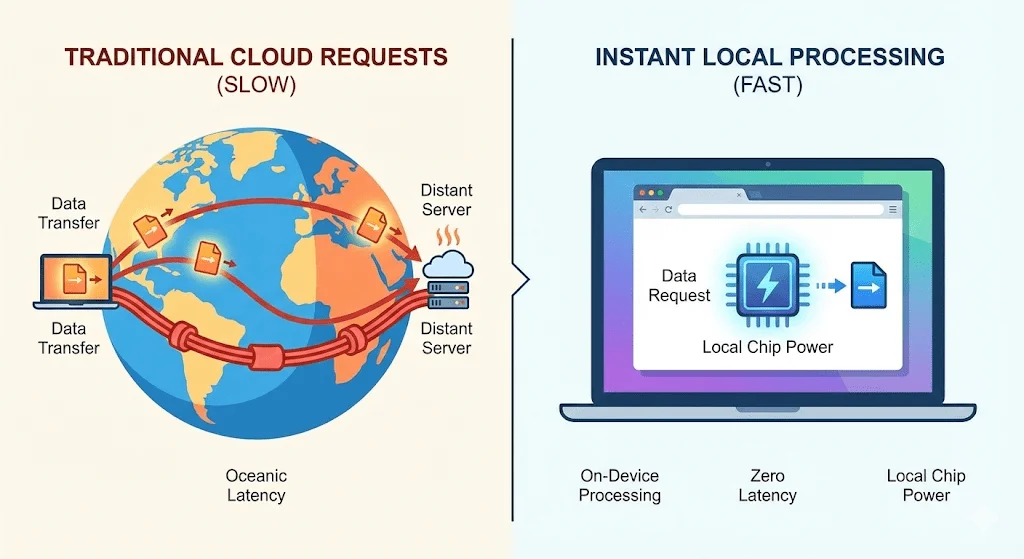
For the last decade, artificial intelligence has lived in the cloud. Every time you asked Siri a question, generated an image, or used an AI writing tool, your input first had to travel thousands of miles to a server, wait in line behind millions of other requests, get processed, and then travel all the way back.
The system mostly worked. But it was never truly fast, never truly private, and certainly never cheap for developers, who had to pay for every token, GPU cycle, and request.
But something has shifted.
At the edges of the internet, quietly, a revolution has been building. And it’s finally exploding into the mainstream in 2025. Call it Edge AI: the notion that AI models can run not on giant server farms but directly on your personal device, inside your browser, or on tiny edge servers located physically closer to the user.
And it is not a prediction any longer. It’s happening right now.
A New Paradigm: AI Without the Cloud
To put that in perspective, try to imagine opening up a website and pulling up an interface where the entire language model-indeed, the whole thing-operates right there, 100% within your browser. No API calls, no waiting, no server, no cloud bill.
It sounds unrealistic, almost impossible. Yet, frameworks like WebLLM, TensorFlow.js, and ONNX Runtime Web have made this not only possible but also shockingly smooth. Developers are packaging optimized versions of models such as Mistral, Gemma, and even Llama-3 directly into web apps. The browser is the new runtime for AI.
The biggest breakthrough? Your device isn’t just displaying the AI, it’s computing it.
That is to say, the response time is virtually real time, the level of privacy is absolute, and business cost is practically zero. It makes the relationship between user and AI become direct, intimate, and autonomous-no cloud middleman required.
Server-Side AI vs. Client-Side AI: Same but Different Worlds
For years, the only practical place to run intelligence was in the cloud. The AI models were too big, too bulky, and too computationally expensive to run anywhere else. Shrinking model architectures, faster CPUs, and browser-based GPU acceleration have turned the tables.
Server-side AI is still powerful, but now it comes with a long list of tradeoffs: latency, server overload, token limits, privacy concerns, and cost. That’s something you can feel every time ChatGPT says “I’m experiencing heavy demand” or a developer complains about their skyrocketing GPU costs.
Client-side AI is a different world entirely.
The user’s device becomes the engine of intelligence. A request doesn’t travel around the planet; it stays inside your laptop or phone. There’s no waiting for a server to respond, no risk of a company storing your data, and no recurring bill for developers. AI becomes something personal-something yours.
This is a sea-change with huge implications. The bottleneck is no longer infrastructure; it’s just about how powerful the user’s device is. And that gap is dramatically shrinking, thanks to WebGPU, WASM, and mobile hardware acceleration.
Why Everyone Is Suddenly Talking About Edge AI
That idea isn’t new. But 2025 is the year it finally clicks-not because of hype, but because of technical maturity.
The browsers got smarter. The models got smaller. The hardware got faster.
And suddenly, the advantages of Edge AI have become too big to ignore. The first thing you notice is the speed. When you run a model locally, the delay is gone. Every interaction feels more fluid, more natural, more… intelligent.
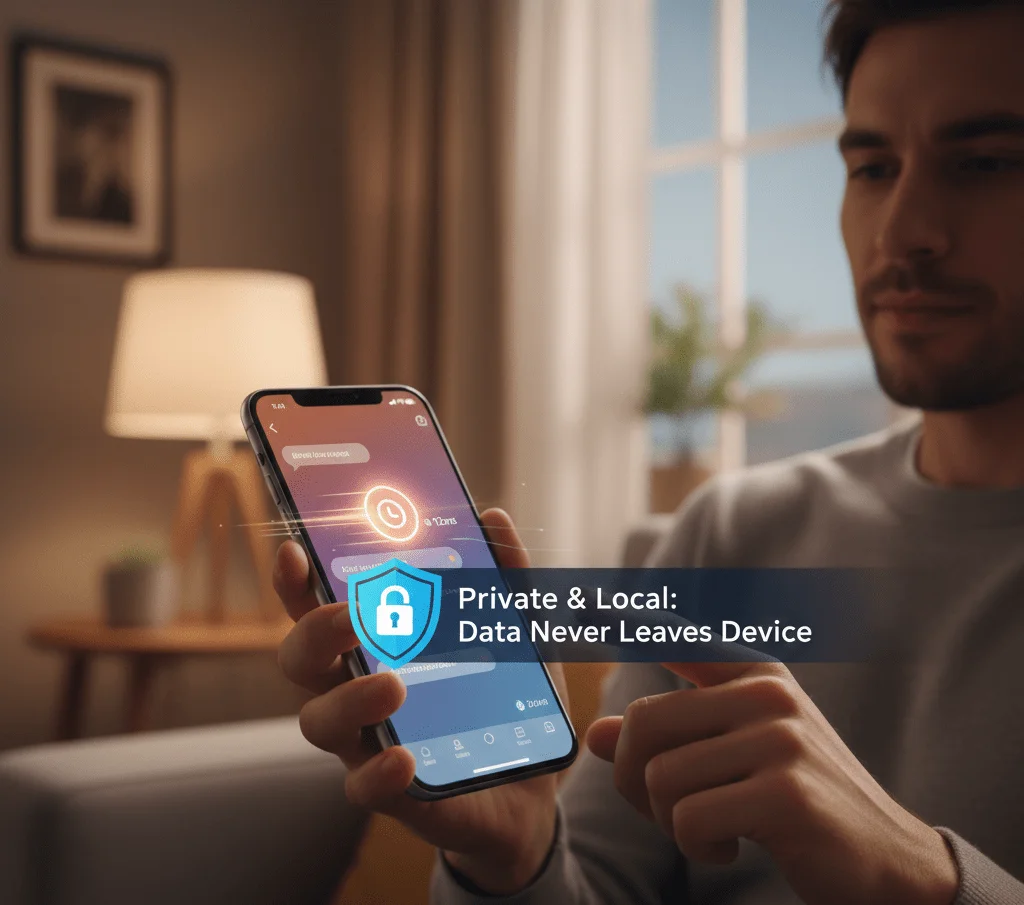
Privacy changes too. No data ever leaves your device. Your prompts, your photos, and your voice recordings belong to you forever. At a time when people are becoming increasingly skeptical of data collection, this alone is a game-changer.
But the most disruptive impact is economic: Developers no longer need to burn thousands of dollars per month on API calls just to keep their AI app functional. They can ship an application that relies entirely on the user’s CPU or GPU. A company that once struggled under cloud costs can suddenly operate at zero variable cost. The entire business model of AI shifts. The barrier to entry collapses.
That’s why people are saying: “Stop paying OpenAI. Run Llama-3 in your browser.”
It’s not a meme; it’s a roadmap.
The Technology Behind the Transformation
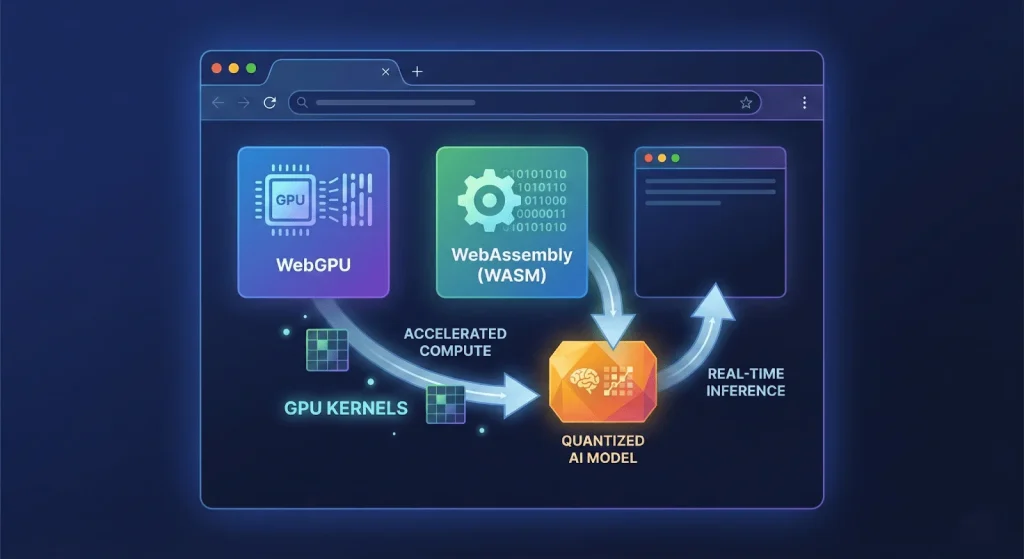
All in all, edge AI requires a perfect storm of technologies that have matured at just the right time.
WebGPU communicates directly with your graphics card from within your browser, doing computes on matrices at blazing speed. It basically turns a simple website into a mini AI workstation that can run models that could otherwise have required powerful, external hardware.
Optimized model architectures, like quantized versions of Llama, GPT-style models, or vision transformers, minimize the size without sacrificing capability. Compressed models are lightweight in loading, efficient at running, and can operate completely offline.
Frameworks such as WebLLM handled the translation layer that lets those models work in a browser environment. This isn’t just a technical trick, but a new ecosystem where developers can ship intelligent applications without having to maintain any backend infrastructure.
These innovations together are building a world where AI is no longer chained to cloud dominance but can instead live at the edges, closer than ever to users.
The Browser as the New AI Operating System
There’s a larger philosophical shift behind all this: browsers are slowly turning into operating systems. They are capable of running video editors, 3D tools, code compilers, and now AI models, all without installation and all without cloud computing.
Your browser is fast becoming your personal AI computer.
This inversion from cloud-first to client-first puts power back into the hands of users. Applications become faster and more secure. Devices become more autonomous. The experiences become more personal.
We are entering a world that will be distributed, not centralized. A world where AI will belong to the user, not the server.
The Future: A Personal AI Running in Your Pocket
Not hard to guess where this is going.
Soon, your phone will run models that today require data centers. Your laptop will host AIs that know your workflow better than any cloud service ever could. Your browser will become a private AI hub capable of writing, analyzing, generating, compressing, predicting, and creating-all locally.
Edge AI doesn’t replace cloud AI, but rather complements it. Heavy-duty models will still need servers, but everyday intelligence will live right on your device: the personal assistant, the note-taker, the translator, the voice companion, and the problem solver.
Because of that, these AIs will be much less like tools and more like companions.
They respond quicker. They know more about you. They protect your data. And they’ll never lock you behind a paywall.
It will not be a million servers humming in a warehouse powering the AI future; it will be powered by the device sitting in your hands right now.
In many ways, that future has already begun.