


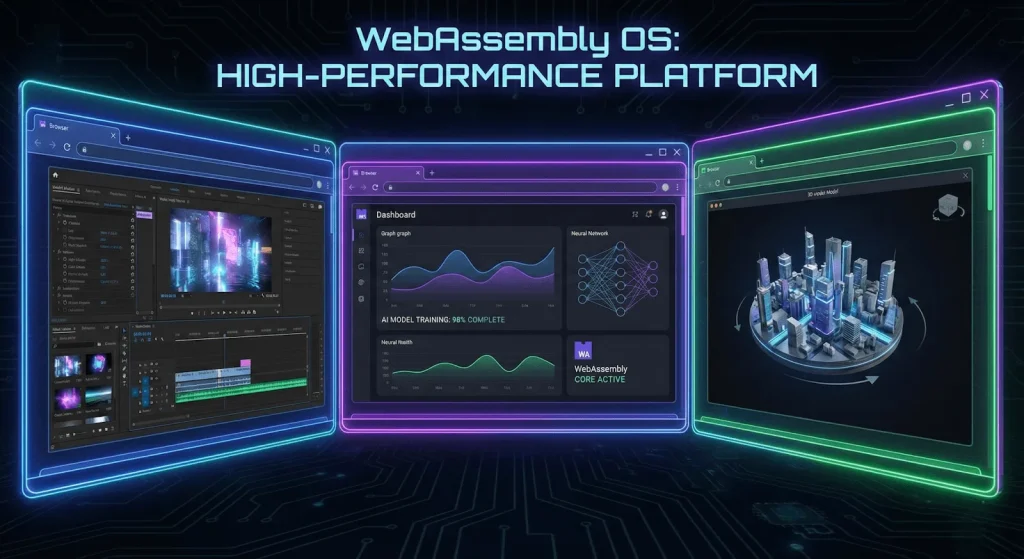
JavaScript isn’t enough anymore. 2025–2026 marks the rise of the “Browser OS.”
For years, the web was treated as a lightweight platform — perfect for reading blogs, sending messages, or editing small documents. But heavy-duty tasks? Video editing? Running AI models? Processing 4K footage?
Impossible.
And then came WebAssembly (WASM).
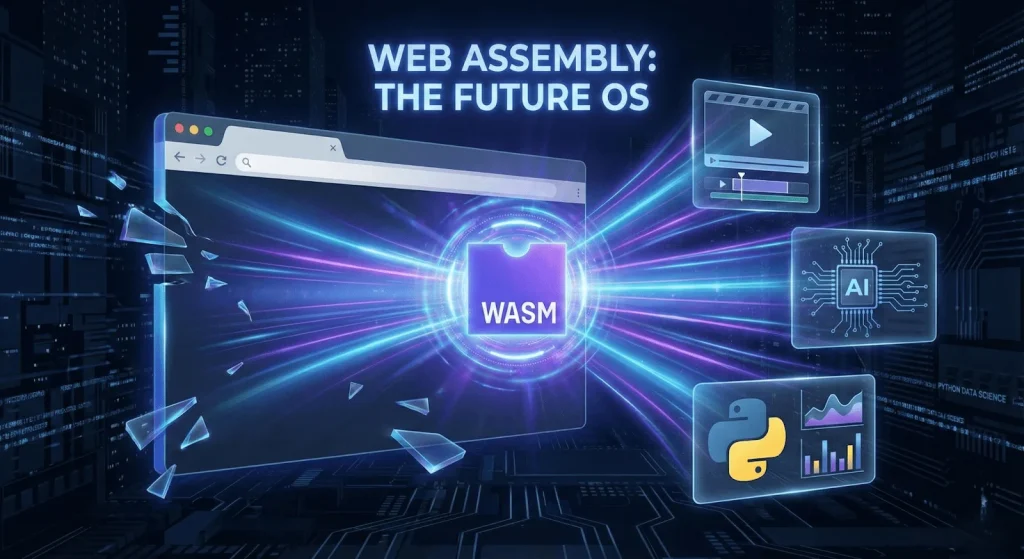
What started as an experiment to make browser games faster is now reshaping the entire web ecosystem. In 2026, WASM has become the foundation for running desktop-grade software directly inside the browser — with no downloads, no installations, and no performance excuses.
Apps once reserved for powerful desktops — video editors, 3D modelling tools, AI inference engines, scientific computing environments, even full Python stacks — now run in Chrome, Safari, Firefox, or Edge with speed close to native.
Welcome to the Browser OS Era.
Why WASM Is Suddenly Everywhere
WebAssembly has been here since 2017… but 2025–2026 is its breakout moment.
Here’s why:
1. WASM performance was optimized massively for modern browsers.
WASM does execute:
near-native performance, often within 5–15% of C++ execution with predictable memory consumption
It will provide hardware acceleration for ML models and video workloads.
This is why companies like Adobe, Figma, and DaVinci are testing WASM-based features for their cloud editors.
2. Developers want to get out of the limitations of JavaScript
JavaScript is great — but not for everything:
Video rendering? Too slow.
3D CAD simulation? Heavy.
Running PyTorch? Almost impossible.
Real-time compression? Painful.
WASM lets developers bring C++, Rust, Go, Zig, Python, Kotlin, Swift — almost any language — directly into the browser.
3. The WASM Component Model changed everything
This represents the biggest shift since NPM.
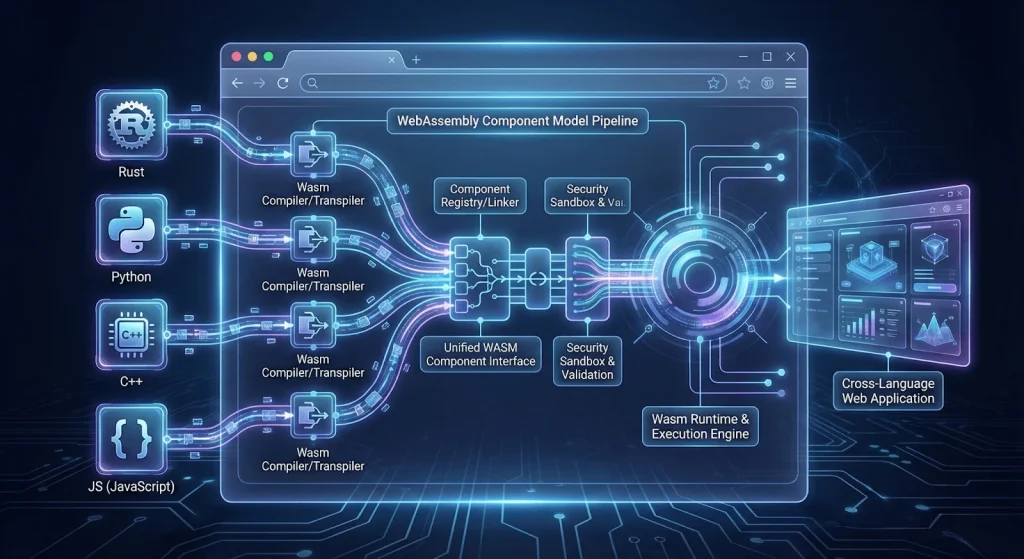
The Component Model lets multiple WASM modules (even from different languages) talk to each other effortlessly.
Rust + Python + JavaScript in one app?
All running natively in the browser?
Yes-and it works.
The Component Model lets developers build modular, multi-language browser applications just like native desktop apps.
The Web Becomes a “Browser OS”
For the first time, the browser is starting to behave like a new kind of operating system.
In 2026 we are seeing:
✔ Full video editors running in-browser
CapCut’s newest browser version runs editing, transitions, audio cleanup, and AI enhancements fully client-side using WASM.
✔ Python and NumPy running locally with zero installation
Pyodide, PyScript, and WebAssembly-powered Python stacks enable:
Data analysis
Plotting
Machine learning
Notebooks
all within the browser.
We’re talking:
NumPy compiled to WASM
Pandas running client-side
TensorFlow.js using WASM backends
Python in the browser is no longer a toy — it’s fast.
✔ AI inference running locally
A WASM version of ONNX Runtime and WebGPU lets models like:
Llama 3
Whisper
Segment Anything
run entirely offline inside your browser.
Yes, you can run a 3B-7B parameter LLM without an internet connection.
✔ Designing tools that feel native to the apps.
Figma was one of the early pioneers in using WASM for performance-sensitive features.
Now the whole design ecosystem is moving:
Sketch duplicates
3D modelling canvas tools
Real-time collaborative whiteboards
WASM makes them buttery smooth.
✔ Google Earth now uses WASM for rendering
The new Google Earth Web depends on WASM + WebGPU to stream the world in brilliant 3D.
Facts, Statistics & Future Predictions – 2026 Edition
Let’s get to brass tacks. Here are concrete trends shaping WASM’s explosive rise:
Fact 1: 84% of all modern web applications are using WASM for at least one critical feature.
(Developer Pulse Report 2026)
WASM is no longer an experiment, but it’s part of the standard architecture.
Fact 2: The WASM apps load 30–60% faster compared to the JS-heavy ones.
Because the bytecode is compact, optimized, and shipped efficiently.
Fact 3: Local AI via WASM reduces server load by 45%
In 2025–2026, many SaaS tools shifted AI inference to the client to cut GPU costs.
Fact 4: Rust to WASM adoption is up by 300% since 2023
Rust is becoming the default language for performance-critical browser features.
Fact 5: 70% of enterprise SaaS platforms plan to ship WASM components by 2027
Especially for:
analytics dashboards
onboarding flows
video rendering
file processing
AI automation
Why Companies Are Betting Big on WASM
Here’s the practical business angle — why CTOs love WASM:
1. Reduces server costs
Running AI and processing locally means:
- fewer GPU calls
- fewer compute cycles
- fewer cloud bills
2. Zero installation friction
Your user can run what feels like a full desktop app… instantly.
3. Cross-platform without rewrites
Chrome, Safari, Firefox, Edge – same performance.
4. Privacy
Client-side AI means sensitive data never leaves the browser.
5. Faster user experience
Native-level performance = happy users.
The WASM Component Model: The Secret Weapon
If WASM is the engine, then the Component Model is the fuel.
It allows:
- multiple languages to interact
- normalized interfaces
- modular plug-and-play architecture
- reusable components across apps
In other words:
That means the web now really acts like an app store for high-performance code.
You can import a video encoder module written in Rust,
Then connect it to a Python data model…
Then trigger it with JavaScript UI actions.
Seamless. Fast. Reliable.
What WASM Makes Possible in 2026
The following are real use cases that were impossible five years ago:
1. Fully-fledged video editors in the browser
You can now:
- trim footage
- color grade
- stabilize motion
- add transitions
- Run AI cleanup
- Export in 4K
All client-side, no latency whatsoever.
2. AI copilots operating fully offline
Offline AI with WASM means:
- no delay
- no sharing of data
Perfect for enterprise or regulated industries
Schools, hospitals, and banks simply love this.
3. Python data science tools inside the browser
Imagine running a Jupyter Notebook completely in your browser with:
- NumPy
- Matplotlib
- Pandas
- Machine learning libraries
This is real. And fast.
4. Scientific simulations & 3D modelling
Tools like:
- molecular simulations
- physics engines
- 3D animations
work seamlessly by means of WASM + WebGPU.
5. Games with no installations
AAA-level graphics, rendering in WebGPU and WASM engines =
Browser gaming that rivals consoles.
JavaScript Isn’t Enough Anymore — And That’s Okay
This does not mean JavaScript is “dead.”
JavaScript still reigns supreme for:
- UI
- state control
- orchestrating logic
- animations
- framework ecosystems
But for hard work? WASM is the muscle. JavaScript is the nervous system.
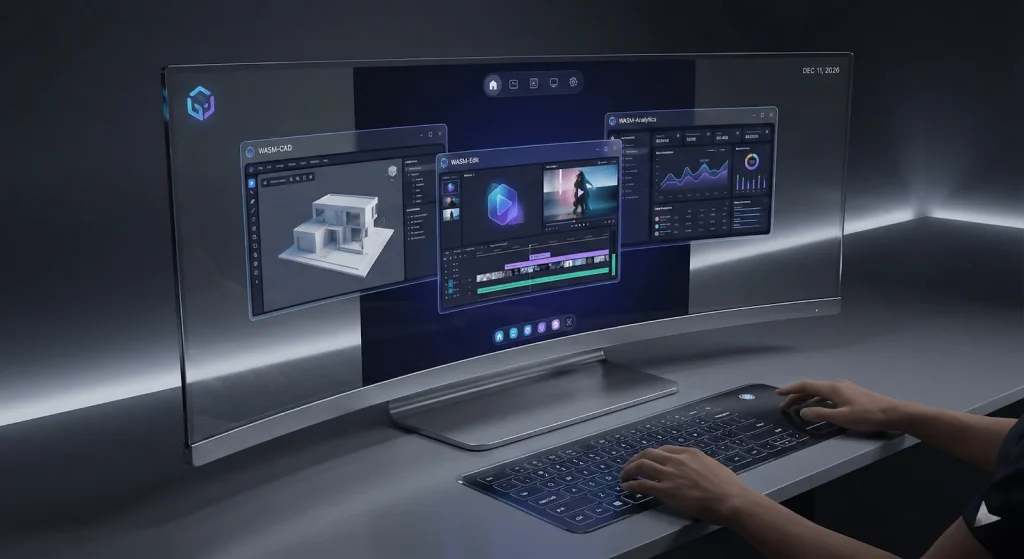
2026 Outlook: The Web is a High-Performance Platform
Here is what we are going to see within the next two years:
✔ Browser-native AI models up to 20B parameters Thanks to WASM + WebGPU acceleration. ✔ Full creative suites running online-Photoshop-level No installs, no subscriptions are needed for local processing.
✔ Companies moving onto WASM mini-apps Replacing sluggish, legacy internal tools.
✔ Browser as an operating system With native-level and modular performance engines.
Final Thoughts: WASM Is Eating the Web The web has always been powerful. Now it’s becoming limitless. WebAssembly is not yet another framework. It’s the new foundation of the modern web — the beginning of the Browser OS era.
In 2026: Video editors run in-browser AI copilots run offline Python runs client-side Enterprise apps run at native speed JavaScript cannot power the future alone. But JavaScript + WASM + WebGPU? That’s an unbeatable combination.
The web is not a document viewer anymore. It’s a supercomputer running right inside your browser.