


The reign of simple chatbots is over.
For nearly a decade, websites added chat widgets just because everyone else did. They answered basic questions, handled FAQs, maybe helped reset a password if you were lucky.
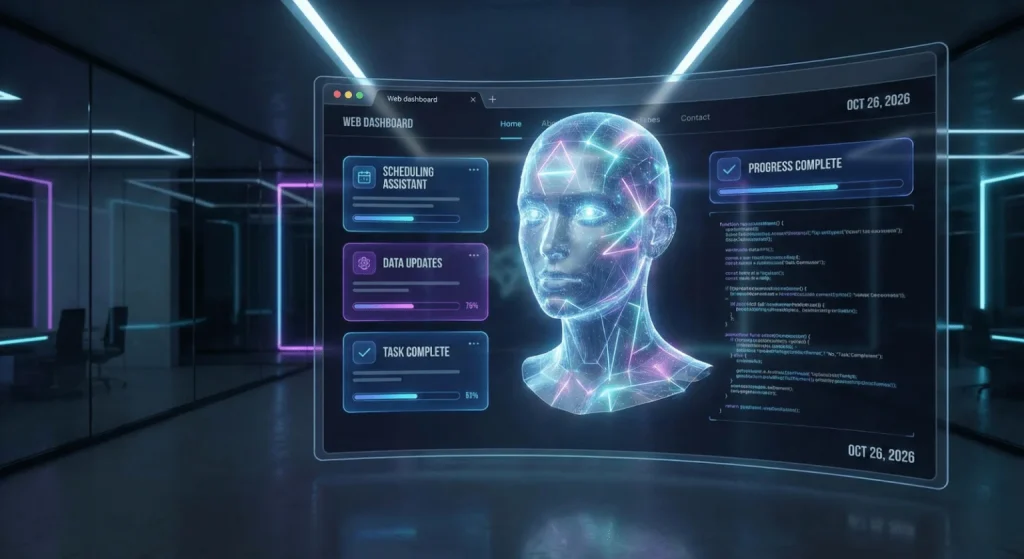
But in 2026, they want more.They don’t want a talking chatbot.They want an AI agent that works.They want an assistant that can book appointments, update records, analyze data, trigger workflows, and get things done — not one that simply replies with paragraphs of text.
This shift is changing the way we develop web applications.
Action is replacing conversation.
Automation replaces each back-and-forth message.
And agents are replacing chatbots.
Welcome to one of the biggest tech upgrades that is shaping the web today.
Why 2026 Is the Year of AI Agents
Companies began to experiment with agents between 2024 and 2025.
But by 2026, they became mainstream.
Here’s why:
1. Users don’t want to manually do everything.
People no longer want to navigate menus, fill forms, or jump across pages for basic tasks.
If your app requires a user to click 11 buttons just to update their profile, trust me — they’re annoyed.
2. Organizations look at reducing manual processes.
AI-driven automation saves time by being cost-effective and enhances productivity.
A 2025 report found that companies using agents saw a 38% reduction in operational workload across customer support, scheduling, and internal operations.
3. Chatbots feel antiquated
By 2025, for example, 54% of users said chatbots “feel repetitive or unhelpful.”
Agents, however, are entities that complete tasks.
4. LLMs evolved – fast
Models in 2026 have:
- better reasoning
- Better memory
- better planning
- power to better perform several things
This evolution makes agents far more capable than the scripted chatbots of earlier years.
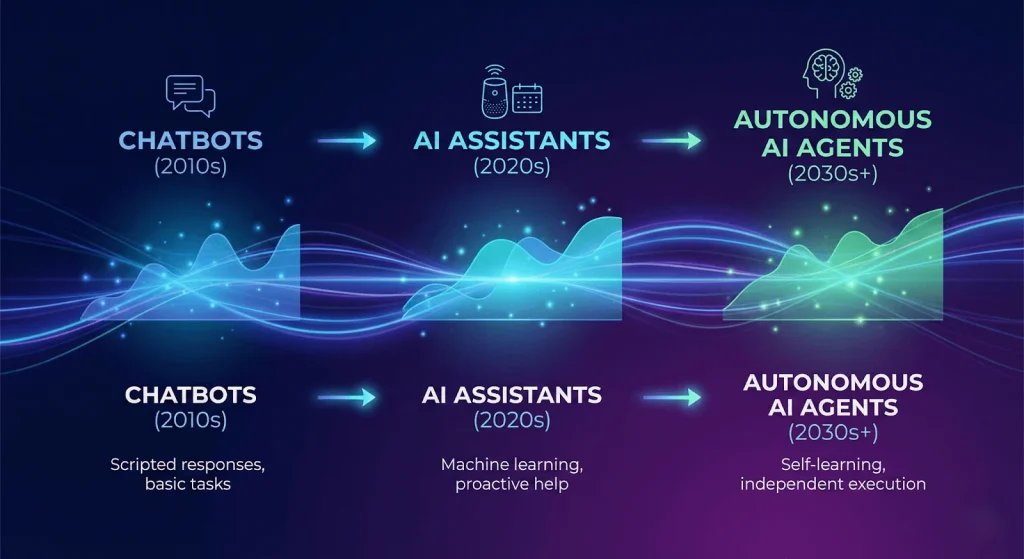
Chatbots vs AI Agents: What’s the Real Difference?
Let’s keep it simple.
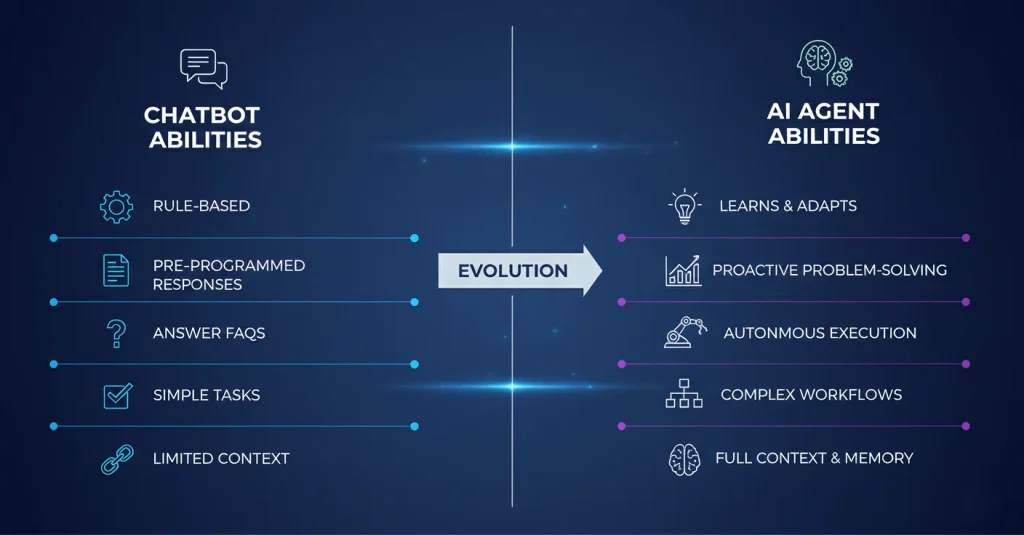
Chatbot = They speak
They answer.
They answer questions.
They follow scripts or model predictions.
AI Agents = They act
They take your request and perform the action.
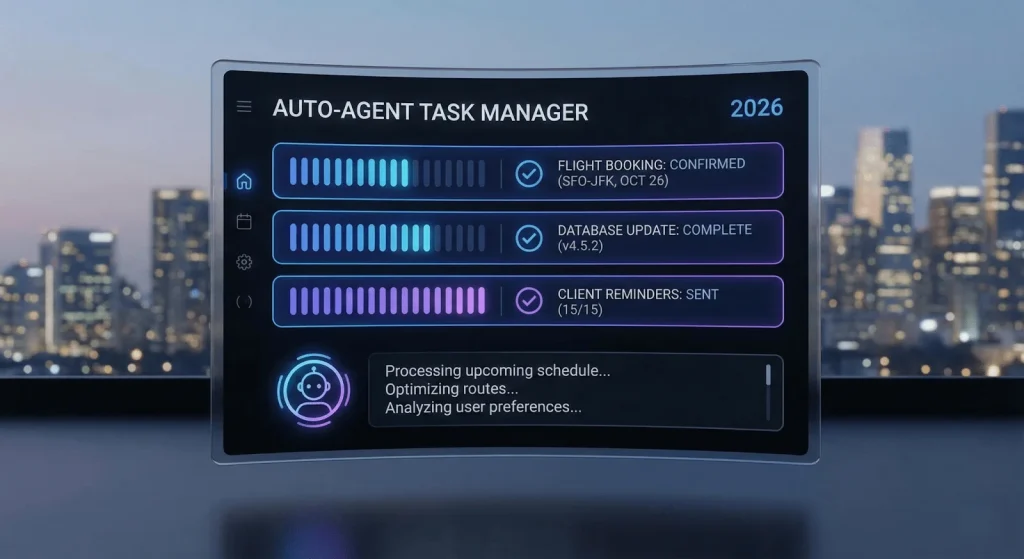
Your web application would allow an AI agent to:
- Book a meeting
- Change your account settings
- Download a file
- Pull data or refresh
- Start a workflow
- Analyze your preferences.
- Overview Opinions
- Narrate your UI silently
- Take decisions based upon the context.
Imagine if you could just tell an application:
“Set up a call with Sam this Friday, and 2 hours in advance, remind me about it.
And the AI does everything in its power-instantly.
That’s what an agent can do.
AI Agents Fit into Web Applications: Use Cases, 2026
AI agents are becoming an “invisible workforce” inside apps. And the best part?
They do not even need to understand how they work – users just feel the convenience.
Let’s walk through real 2026 use cases:
1. Automated Appointment Scheduling
Instead of going through three pages → selecting dates → filling forms…
As would say:
“Book my dental appointment for next Thursday morning.”
The agent checks the availability, selects a slot, books it, and sends confirmation.
That reduces the average booking time from 3 minutes down to 20 seconds.
2. User Profile Updates or Data
Forget swiping around settings.
Now users say:
“Update my phone number and shipping address.”
Done in seconds.
No form filling.
No dropdowns.
No mistakes.
3. Intelligent Suggestions
AI agents are personalizing everything in real-time.
- content
- layout
- product suggestions
- dashboard insights
- reminders
In 2025, applications with personalization had 28% higher user retention.
Agents will push this number even higher.
4. Automating Customer Support
Agents don’t just answer- Agents resolve.
They can:
- Check order status
- Cancel orders
- issue refunds, with rules
- update subscriptions
- process yields
By 2026, analysts expect agents to handle 70% of customer interactions end-to-end.
Why AI Agents Improve User Experience: Statistics
Let’s break down the numbers (based on global reports from 2025 and early 2026):
User Productivity
Apps with agents realized completion rates 34 percent faster.
Clicks reduction
Overall, AI agents removed about 60–85% of manual gestures, depending on the application type.
Conversion Boost
Adding task-capable agents increased conversions by 15–22% for SaaS and booking-based websites.
Cost Reduction in Supporting
Agent-powered automation reduced support workload by as much as 40–65%.
User Expectations
72% of users wanted a system that “acts on its own.”
Writing on the wall is lucid:Agents make everything better: faster, easier, more satisfying, and building trust.
The big question: are AI agents safe?
It is this part that makes developers and founders nervous-and rightly so.Giving AI complete autonomy to act independently is no small thing, certainly.
It comprises risks such as:
- Unauthorized Acts
- Incorrect data updates
- User Intent Misinterpreted
- Doing things without permission
- Over-access to sensitive areas
A 2025 developer survey revealed that 53% worry about “AI overstepping limits.”
So, how do the 2026-ready apps handle this?
They use guardrails.
✔ Have sensitive tasks’ requests confirmed
✔ Access layers
✔ Clear boundaries of the roles
✔ Activity logged
✔ Multi-step validation for big actions
✔ Task limitations
✔ Secure execution environments
These guardrails make the agent reliable, safe, and predictable.

Why Your Application Should Include an AI Agent Instead of a Chatbot
Here’s the clear truth: Users do not merely look for information. They want solutions.** And AI agents deliver that.
By 2026, users will no longer care about navigating menus, adjusting settings, or dealing with complex dashboards. They prefer to issue a command → and have it carried out.
Applications that utilize AI agents see: improved user retention, higher conversion rates, fewer support requests, increased automation, enhanced brand loyalty, and a more modern experience. In contrast, applications that depend on chatbots will start to seem outdated.
Chatbots = 2016-2023 AI Agents = 2024–2030 Your users may forget every button in your application — but they will recall how effortlessly you accomplished tasks.
The Future of Web Applications Is with AI Agents
By the end of 2026, industry experts predict: 1 in 3 web applications will implement a complete AI agent. Agents will manage over 50% of standard user tasks.
Support teams will cut their workload in half SaaS platforms will introduce dashboards driven by agents E-commerce will employ agents for complete order management Developers will design applications around actions rather than user interfaces.
Think of your AI agent as your user’s personal assistant within your application. It learns. It adapts. It oversees tasks. It becomes an integral part of their experience. The future is not about conversation — it focuses on actions, independence, and agent functionality.

Final Thoughts
The question for developers and entrepreneurs today is no longer: ❌ “Should we add a chatbot?”
The crucial question is: “What tasks can our AI agent perform for our users?” If you want your product to seem modern, smooth, and future-ready, then adding an AI agent is not just a nice-to-have — it’s necessary.
Your users are ready. Your competitors are progressing. Your application requires it. And in 2026, the successful applications will be those that not only converse — they take action.