


Digitally, everyone’s searching for that secret spice to boost their website traffic like never before. It’s not just about getting people to visit your site; it’s about making them stick around and come back for more. The magic wand for this lies in how you structure your website—it can be the game-changer that skyrockets your traffic by a whopping 40 times!
Creating a website structure that not only attracts but also engages visitors is a powerful secret to boosting traffic. In this blog post, we’ll delve into key strategies that can elevate your website’s traffic by up to 40x.
1. Market Research by Analyzing the Top Websites
First things first, you must carefully analyze the market. Examine the websites of your rivals to find recurring themes in your sector. Having a clear understanding of what functions well and what does not can help you make important structural decisions.
Furthermore, specify who your target market is. When navigating websites, be aware of their expectations, habits, and preferences. To guarantee a user-centric approach, this knowledge will direct your structure decisions.
2. Develop a Clear Hierarchy
Content hierarchy on a website is not just about prioritizing important pages in the web design; it’s also about how the pages of your website relate to each other. When looking at the content hierarchy for an entire website, the most important pages are included in the navigation, while supporting pages are included in sub-navigations or secondary navigation, in addition to strategic internal links that connect related pages.
3. Make a Conversational Home Page
Craft a homepage that speaks directly to your audience. Use language that resonates with them and clearly communicates your brand message. A conversational tone creates a connection and makes your website more approachable.
Benefits of Custom-written Software
1. Scalable
As businesses evolve, their software needs change. The custom-written software is designed to scale with the project, matching increased functionality with other features, without compromising performance.
Stat: According to a report by Grand View Research, the global custom software development market is expected to grow at a CAGR of 22.3% from 2020 to 2027, driven by the increasing importance of scalable solutions.
2. Integrating existing systems
Custom software can be designed to seamlessly integrate with existing IT infrastructure, ensuring efficiency and data consistency across the organization. This is often the biggest challenge in a solution that does not of applications that may not be compatible with overall policy.
3. Long-term cost-effectiveness
While the initial investment in custom software can be significant, the long-term benefits often outweigh the costs. Custom software eliminates the need for constant updates and licensing fees, resulting in significant long-term savings.
Benefits of Custom Software for Businesses
1. Personalized User Experience
Custom software offers the flexibility to be precisely tailored to the unique needs of different industries, whether it’s healthcare, finance, retail, or manufacturing. Each industry has its own set of challenges, regulations, and operational requirements that off-the-shelf software may not adequately address. For example, in the healthcare industry, custom software can be designed to comply with strict privacy regulations like HIPAA while also catering to specific patient management needs. In finance, it can incorporate specific compliance measures and risk management tools that are essential for maintaining financial integrity. By developing industry-specific software, businesses can ensure that their operations are fully supported by a solution that understands and addresses their unique challenges, leading to greater efficiency, compliance, and overall success.
2. Enhanced Customer Relationship Management
Custom Customer Relationship Management (CRM) solutions provide businesses with a more personalized and effective way of managing customer interactions and relationships. Unlike generic CRM systems, custom solutions can be designed to align perfectly with a company’s customer engagement strategies, allowing for more targeted communication, personalized marketing, and efficient issue resolution. This tailored approach helps businesses build stronger relationships with their customers by addressing their specific needs and preferences, which in turn improves customer retention and loyalty. A well-designed custom CRM can also provide valuable insights into customer behavior, enabling businesses to anticipate needs, respond to concerns more quickly, and deliver a more satisfying customer experience.
3. Streamlined Supply Chain Management
For businesses involved in manufacturing, logistics, or any other industry that relies on a complex supply chain, custom software can be a game-changer. By optimizing supply chain management, custom software helps reduce costs, improve delivery times, and enhance overall operational efficiency. It can integrate various aspects of the supply chain, from inventory management and procurement to production and distribution, into a single, cohesive system. This integration allows businesses to track and manage their supply chains in real-time, quickly identify and resolve bottlenecks, and make data-driven decisions to improve performance. As a result, businesses can respond more rapidly to market demands, reduce waste, and increase profitability.
Why Choose Custom Software Development?
1. Alignment with Business Objectives
Custom software development is specifically designed to align with the strategic goals of a business. Unlike off-the-shelf solutions, which offer generic features, custom software is built to address the specific needs and objectives of a company. This alignment ensures that every function and feature of the software supports the company’s unique goals, whether it’s improving customer service, streamlining operations, or expanding into new markets. By focusing on what truly matters to the business, custom software enhances efficiency and effectiveness, helping the company achieve its strategic objectives more quickly and with greater precision. Moreover, custom software can adapt to changing business needs over time, ensuring that it continues to support the company’s long-term goals.
2. Higher Return on Investment (ROI)
Investing in custom software can lead to a higher return on investment by significantly improving efficiency, reducing operating costs, and boosting productivity. While the initial cost of custom software development may be higher than purchasing off-the-shelf solutions, the long-term benefits often outweigh the upfront investment. Custom software eliminates unnecessary features and focuses on automating and optimizing key business processes, leading to time and cost savings. Additionally, by streamlining operations and reducing the need for manual intervention, custom software can increase productivity and enable employees to focus on more value-added tasks. These improvements translate into increased profitability, making custom software a wise investment that pays off over time.
3. Future-Proof Solutions
One of the major advantages of custom software development is the ability to create future-proof solutions. Custom software can be developed with scalability and flexibility in mind, ensuring that it can evolve with the business as its needs change over time. Whether it’s adding new features, integrating with emerging technologies, or scaling up to accommodate growth, custom software is designed to remain relevant and effective for many years to come. This future-proof approach reduces the need for costly replacements or major overhauls, providing businesses with a long-term solution that adapts to their evolving needs. By choosing custom software, businesses can stay ahead of the curve and remain competitive in a rapidly changing market.
Why Off-the-Shelf Solutions Fall Short?
1. Not making Changes
Off-the-shelf solutions are designed for many audiences, making it difficult to find the exact right product for a specific business need. This often results in interventions and management strategies.
2. Integration Issues
Integrating just a small amount of software into existing systems can be complex and expensive. Major adjustments and new equipment may be required to achieve compatibility.
3. Limited Interchangeability
Off-the-shelf solutions may not scale well into the project, leading to performance issues and the need for frequent upgrades or replacements.
4. Long-term Cost Effectiveness
While initially cheaper, the long-term costs are often higher due to licensing fees, product upgrades, and the need for new software to cover functional gaps.
Stat: Software Advice found that 64% of businesses incur hidden costs on off-the-shelf software, including customization, integration, and training costs.
Conclusion
In conclusion, although out-of-the-box solutions may seem attractive due to their low initial cost and speed of deployment, they often fail to consume businesses meeting specific needs.
Custom software solutions offer significant advantages in terms of simplicity, scalability, security, and scalability. By investing in custom software, companies can maximize ROI, gain a competitive advantage, and ensure that their software keeps pace with their needs.
Tags: app development, custom software development, custom software solutions, Hire Dedicated Developers, ios app developers, software development, Staff Augmentation services
- Put Important Information First:
Capture visitors’ attention by placing crucial information prominently. Whether it’s a special offer, key product/service details, or a compelling call-to-action (CTA), ensure that important elements are easily accessible without excessive scrolling.
- Use a Content Hierarchy to Help Visitors:
Guide visitors through a logical content flow. Present information in a structured manner, leading them from broader topics to more specific details. This not only aids comprehension but also encourages users to explore more of your content.
- Meet Visitor Expectations with Well-Organized Footers:
Often overlooked, footers play a crucial role in user navigation. Organize footer content intuitively, including links to important pages, contact information, and relevant resources. A well-organized footer can be a valuable tool for retaining visitors.
- Make Two-Way Conversations with CTA:
Transform your call-to-action (CTA) buttons into a two-way conversation. Instead of generic phrases, use CTAs that invite interaction. For instance, “Explore Our Solutions” or “Start Your Journey Here.” Encouraging engagement through CTAs enhances user involvement.
4. Identify Your Structure:
Before selecting a model, make a list of the categories you want on your website and the number of pages you anticipate needing. No single structure works for everyone. However, these three most popular structures can serve as your source of inspiration.
- Linear Model:
Create a step-by-step linear flow for straightforward user journeys.

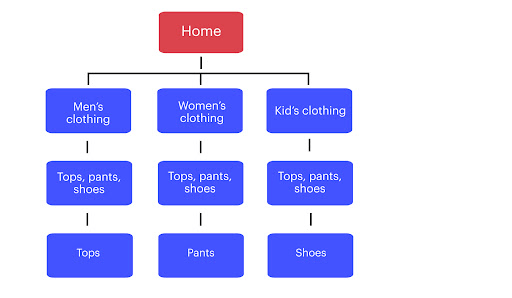
- Hierarchical Model:
Organize content hierarchically, with main categories and subpages for detailed information.
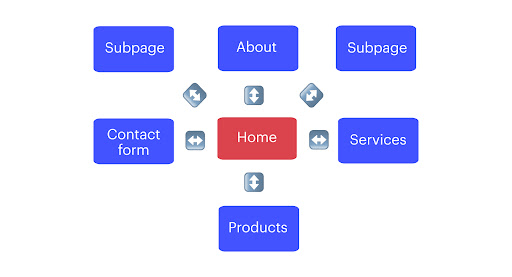
- Webbed Model:
Interconnect content for a more flexible, interconnected browsing experience.
5. Limit Clutter in Header
Imagine walking into a store where everything is neatly organized and manageable. That’s the vibe we’re aiming for with your website header. A clean and focused header ensures a smooth and enjoyable user experience. By limiting the number of menu items, we’re essentially decluttering the virtual space, preventing visitors from feeling lost in a sea of options.
Prioritize the most important sections and maintain a minimalist design for a streamlined user experience.
6. Build a User Flow Diagram
User flow is the roadmap for the user experience from beginning to end. You must decide what you want the user to do, whether making a purchase or signing up for a newsletter, and develop a user flow to define how they’ll get there. Also, following a step-by-step view of their user experience ensures you don’t miss any steps while creating a website structure. Hence, understanding this flow helps optimize the user experience and encourage desired actions.
7. Focus on Buyer Personas When Creating Your Pages
While building web pages, tailor your content to your target audience. What are they looking for? Why do they land on your website? Make the path easier for them to follow so they can peruse your website. Make your objective clear to them and provide examples of the action they should take, such as call-to-actions.
So, tailor your website content to resonate with your buyer personas. Understand their needs, pain points, and preferences. Craft pages that speak directly to these personas, increasing the likelihood of conversion.
Conclusion
From a clear content hierarchy to a conversational homepage, each element plays a crucial role in creating an engaging user experience.
Choosing the right website structural model, maintaining a clean header, and focusing on user personas are the building blocks for success. Your website becomes a dynamic space where every click is purposeful, making visitors not just passersby but eager explorers.
So, as you architect your digital space, consider it more than just a website—it’s an interactive journey. With a thoughtful structure, your online presence becomes a compelling force, drawing visitors in and keeping them coming back for more.